

Cryptocurrency is a fully digital asset that operates on a decentralized network without a centralized issuer. Its technical foundations are cryptography and a distributed database. This article is a beginner’s guide to cryptocurrency. We will provide a comprehensive review of the principles of cryptocurrency in an easy-to-understand format.
Table of Contents
What is a cryptocurrency?
A cryptocurrency is a digital currency that uses cryptography and a distributed database. Bitcoin was the first cryptocurrency, launched in January 2009. Since then, millions of new cryptocurrencies have entered the market.
A key feature of a cryptocurrency is its decentralized operation. Each cryptocurrency is essentially a network of thousands of computers (servers). These operators maintain a decentralized database of transactions and validate new ones. Most cryptocurrencies use a blockchain as a database.
The user manages their cryptocurrencies using a crypto wallet. A crypto wallet is a graphical user interface (GUI) to the network and resembles an online banking app in appearance and functionality. A crypto wallet can be used to send, receive, and store crypto.
Cryptocurrencies operate outside the traditional banking system. Most cryptocurrencies are also open networks, meaning anyone can join the network by running the required software and following the consensus rules.
The biggest difference between a cryptocurrency (like Bitcoin) and a fiat currency (like the euro) is the issuance and control. The euro is a currency issued by the European Central Bank and derives its value from people’s trust in the broader monetary system.
Cryptocurrencies are not under the control of a single entity. Their value is formed in the free market, and their issuance and reserves cannot be manipulated. Unlike fiat currencies, which central banks can create out of nothing without any limits.
Cryptocurrencies are not legal tender globally (except for specialized jurisdictions). Therefore, shops and services are not obliged to accept crypto payments. Some do regardless, mostly because of marketing and the desire to attract crypto investors as customers.
It is also important to understand that the term “cryptocurrency” is somewhat misleading. Nowadays, the term “crypto” is more commonly used. This is a better option because most cryptos are not currencies in the true sense of the word.
Summary of cryptocurrency
| Summary of cryptocurrency | |
|---|---|
| 💻 | Cryptocurrency is a purely digital currency that cannot be converted into banknotes or coins. |
| 🌐 | Cryptocurrency operates as a decentralized P2P network open to anyone. |
| 🔒 | Cryptocurrency relies on cryptography for its technical operation. |
| 🧩 | Cryptocurrency uses a decentralized database for data storage (often a blockchain). |
| 🌍 | Globally distributed administrators (validators or miners) maintain the decentralized database. |
| 🗂️ | There are various crypto assets on the market, such as currencies, smart contract platforms, stablecoins, and meme coins. |
| 👤 | There are millions of cryptocurrencies on the market, and anyone can create a new one with a very low barrier to entry. |
| ₿ | The world's oldest, most well-known, and largest cryptocurrency by market cap is Bitcoin. |
| 👥 | Hundreds of millions of people worldwide invest in crypto. |
| 💰 | Cryptocurrencies can be purchased on cryptocurrency exchanges or decentralized DeFi trading platforms. |
Cryptocurrency categories
There are various types of cryptocurrencies, but only a few qualify as digital currencies. Below is a breakdown of the most common crypto categories.
- Currencies are cryptos such as Bitcoin, Litecoin, and Bitcoin Cash. Their main purpose is to transfer and store value. These are cryptocurrencies in the true sense of the word.
- Smart contract platforms are operating systems for decentralized apps. Such crypto serves as the platform’s native currency and is used to pay transaction fees and for staking. The most popular smart contract platform is Ethereum. Other well-known platforms include BNB, Solana, and Cardano.
- Tokens differ from currencies in that they do not have their own blockchain. Tokens are created on smart contract platforms. Tokens are often associated with a specific app. Chainlink, Aave, and Uniswap are examples of tokens.
- Stablecoins are primarily dollar-pegged tokens used as a substitute for fiat currencies. In addition to the dollar, there are stablecoins backed by other fiat currencies (e.g., the euro). The most popular stablecoins have been launched on dozens of different platforms.
- Memes are tokens created purely for fun and speculation, with no real purpose. Most meme coins are created on the Solana platform.
The list above outlines the main categories of crypto. In addition to stablecoins and memes, there are dozens of subcategories under the token category, such as DeFi tokens, AI cryptos, and gaming tokens. Most cryptocurrencies on the market are tokens.
How does cryptocurrency work technically?
Next, let’s go over how cryptocurrency works from a technical standpoint.
Cryptocurrency network and maintenance
From a technical perspective, cryptocurrency is a decentralized network that consists of computers (servers) running client software. Each cryptocurrency has its own client software, developed by a decentralized community or a tech company. The more people run the client, the more decentralized the cryptocurrency becomes.
Each cryptocurrency has a group of actors responsible for maintaining the network. They are called network nodes. The roles and functions of the nodes differ slightly depending on the cryptocurrency. For example, Bitcoin has separate nodes that mediate transactions and miners that maintain the blockchain.
Most cryptocurrencies are not minable, like Bitcoin. They are maintained by validators instead of miners. Whether a cryptocurrency is mineable or not, each cryptocurrency has a set of administrators who validate network transactions and/or maintain the blockchain.
This is how a cryptocurrency works in practice:
- 📱 The user makes a transfer request from their crypto wallet: x amount of cryptocurrency from address A to address B.
- 🌐 The crypto wallet processes the transfer request to the network and pays the transfer fee to the network nodes (validators).
- 🖥️ The network nodes (validators) ensure that the transfer complies with the consensus rules and can be processed.
- 🔒 The transfer is stored in a distributed database (most often a blockchain), from which it can no longer be changed.
Cryptocurrencies use a distributed database as their data storage. It mainly contains information about transactions, i.e., how much crypto has been sent from address A to address B. Other data, such as text, images, or videos, can also be stored in the database. However, these are less common uses.
By far the most popular type of distributed database is the blockchain. There are also cryptocurrencies that use DAG technology, which resembles a tree structure rather than a blockchain. These are just a few special cases.
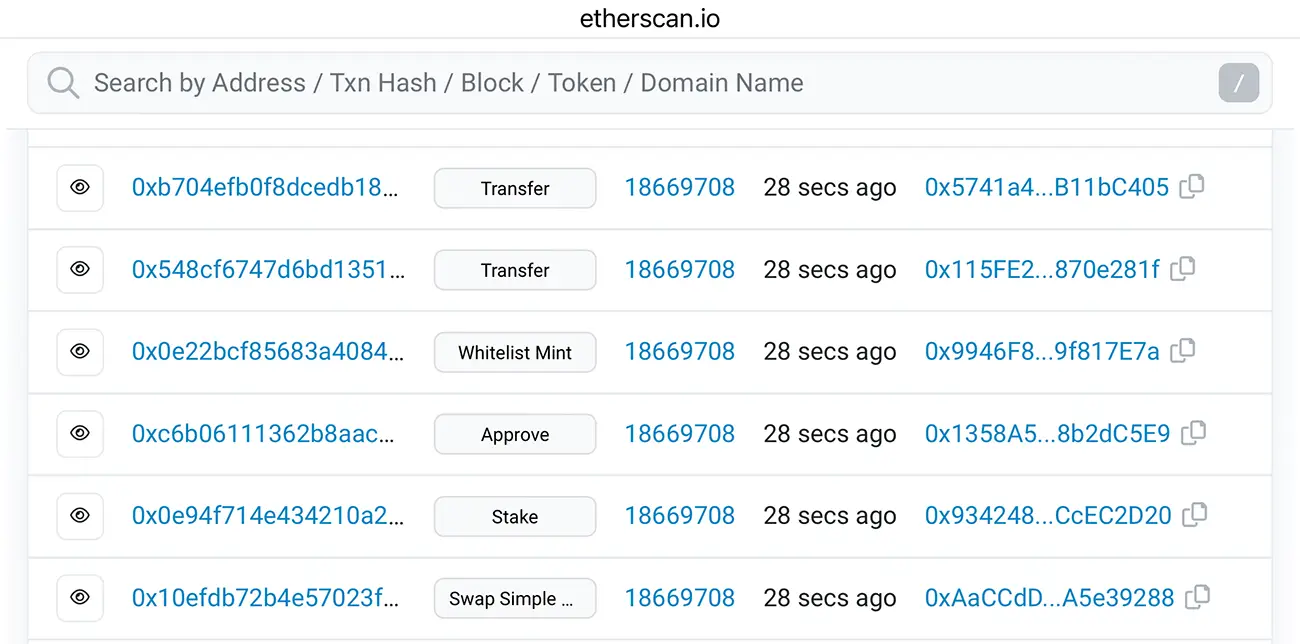
Below is a picture of Ethereum transactions from the Etherscan website. A typical cryptocurrency is pseudonymous, meaning its transaction data is public, but its owner cannot be directly identified from the crypto addresses.
Cryptocurrencies use a decades-old technology called public-key cryptography. It enables the functionality described above. The sender of a cryptocurrency can prove their right to transfer funds using a cryptographic signature.
Cryptocurrencies are stored in crypto wallets. This can be a mobile app, computer software, browser add-on, or a physical device. A crypto wallet acts as a graphical user interface to the blockchain. We will discuss this topic in more detail in the next chapter.
Cryptocurrency wallets and transactions
Cryptocurrency wallets are an essential aspect of their technical operation. The ability to manage funds outside the financial system without third-party control is one of the most fascinating features of cryptos.
Cryptocurrencies can be freely transferred from an exchange to your wallet after the purchase. Today, there are numerous wallets available that support hundreds of different cryptos. This means you don’t need a separate wallet for each cryptocurrency.
The most popular type of crypto wallet today is a mobile wallet, i.e., an app installed on a mobile device. A mobile wallet has convenient features for transfers and payments. You can scan a QR code depicting the recipient’s address with your mobile device’s camera. This reduces the risk of incorrect transfers.
A mobile wallet looks a bit like an online banking app. Below is a picture of the popular Exodus wallet.

The freedom that comes with a crypto wallet also comes with responsibility. It is important to understand that crypto transfers cannot be reversed. If you send your funds to the wrong address, they are gone forever.
Another risk is related to cybercrime. Many crypto investors have fallen victim to scammers and lost their assets, much like in bank fraud.
It is important for a novice user to be aware of the risks associated with crypto wallets. You can avoid risks by initially storing your cryptos on the exchange where you bought them. You can use a crypto wallet later as you gain experience.
Our website offers a comprehensive guide to the different types of crypto wallets.
Cryptocurrency consensus algorithms
Every cryptocurrency needs a consensus algorithm to function. A beginner can think of a consensus algorithm as a rulebook for a cryptocurrency. It defines the rules on which the cryptocurrency’s operating logic is built.
Consensus in cryptocurrency refers to the network’s collective approval of transaction data. Network administrators must reach consensus on each new block (and its transactions) before it can be added to the blockchain.
Cryptocurrencies can be divided into two main categories based on the consensus algorithm:
- 🔨 Proof of Work cryptos
- 🪙 Proof of Stake cryptos
Proof of Work is best known through Bitcoin. Today, it is mainly used by a few older generation cryptocurrencies, such as Bitcoin, Litecoin, and Monero. Almost all new cryptos have used Proof of Stake consensus in the past decade.
Proof-of-work (PoW) requires physical mining equipment to operate. Administrators (in this case, miners) must demonstrate sufficient computational work to be eligible to update the blockchain. Miners are rewarded for their maintenance work (and the computing power used) with block rewards.
Proof of Stake, or PoS, does not require mining equipment to operate. You become an administrator by holding and staking a certain amount of the cryptocurrency in question. For example, Solana validators stake the Solana native token (SOL). Block rewards are also distributed to validators, as they are to miners.
There are also several different variations of Proof of Stake. Almost every PoS system differs slightly from the others in terms of details. The topic is discussed in more detail in a separate guide: What are cryptocurrency consensus algorithms?
Crypto market volatility and risks
The volatility of the crypto market (sharp price movements) is one of the biggest topics of discussion among crypto investors. Cryptocurrencies have gained popularity as an asset class, largely because of their significant price volatility.
Volatility is significant for traders because it provides more trading opportunities than traditional asset classes. Three main factors explain cryptocurrency volatility:
- 🏛️ Crypto market regulation (or the lack thereof)
- 🌍 The size of the crypto market
- 📈 Use of leverage
Crypto exchanges are not subject to the same rules as traditional stock brokers. Crypto markets are also not monitored with the same intensity. This makes it easier to manipulate the crypto market than other asset classes.
Although the crypto market is worth trillions of dollars, it is still a small asset class compared to the stock market, bond market, real estate, or even gold. The smaller the market, the less money is required to move prices.
The popularity of leverage also increases volatility. Some crypto exchanges allow for leverage of up to 100x. When leverage is combined with an already high-risk asset class, it can lead to dizzying price movements due to liquidations, i.e., forced sales of positions.
The size of the crypto market has grown significantly over the past 10 years. For example, Bitcoin’s volatility has begun to decrease as its market capitalization has grown to over a trillion dollars. Despite this, daily increases of tens of percent and weekly increases of over a hundred percent are by no means exceptional for most cryptos.
Crypto investing requires more active price monitoring than traditional stock investing. We have a dedicated page where you can view the current prices of the most popular cryptocurrencies.
Cryptocurrencies as an investment
Cryptocurrencies are a unique asset class, characterized by high volatility. Traditional investors are not used to the kind of price movements that are seen in crypto, especially in smaller coins. Even Bitcoin often experiences drops of tens of percent multiple times throughout a bull market.
Drastic price declines are a problem for inexperienced crypto investors. This is because the fair value of cryptos cannot be assessed in the same way as stocks, and there are no established fundamental models yet. Above all, investors must believe in the crypto industry’s future growth. This belief is rigorously tested during price declines.
Price increases can cause other types of problems. Many novice crypto investors get excited about paper profits and start making additional purchases during parabolic moves. Rapidly rising prices also fuel greed in leveraging, which can lead to large losses when the trend reverses.
Inadequate regulation also brings its own risks. In 2022, widespread bankruptcies resulted in losses for tens of millions of crypto investors. The most famous was the FTX bankruptcy in November 2022.
Some investors believe the risk-return ratio of cryptocurrencies is exceptional despite the risks. Cryptocurrencies have historically offered higher returns than traditional investment classes.
In the crypto market, small investors can also have an advantage over institutional investors. At best, an individual investor can find undervalued projects that large investors do not know how to or cannot exploit. On the other hand, the counterpart to this opportunity is the risk of investing in a worthless asset or even an outright scam.
The size of the crypto market is also a factor favoring small investors. Large pension funds and institutional investors simply cannot invest in small cryptocurrencies because of their low market capitalization. This leaves a certain part of the crypto market entirely in the hands of small investors.
There is a separate article on our website that discusses investing in crypto in more detail.
How to buy cryptocurrencies?
Cryptocurrencies are bought on crypto exchanges. They can be separated into two categories:
- Local crypto exchanges
- Global crypto exchanges
Each country typically has a couple of local exchanges that serve the crypto investors in that region. Local exchanges are smaller, usually charge higher fees, and offer limited services. Their strength is in localization. Many investors also tend to trust local services more, because they know how those companies are regulated.
Binance, Coinbase, and Crypto.com are examples of global crypto exchanges. Each has over 100 million customers. Global exchanges can offer deeper liquidity and extremely low trading fees because of the volume they handle. Global exchanges often lack local language support.
You can find a comparison of the most popular cryptocurrency exchanges and beginner’s guides to different services on our site. If you want to learn more about the exchanges, you can find beginner’s guides by clicking on the Exchanges link in the main menu.
Buying cryptocurrencies is a straightforward process. You can check this detailed guide to buying crypto, which covers all the steps.
Cryptocurrencies can also be bought from decentralized exchanges (DeFi apps). They operate automatically using smart contracts. We will not go into more detail about these services in this article. Take a closer look at Uniswap if you are interested in these applications.
Various derivatives and ETFs have become increasingly popular in the 2020s. Many stock investors want to increase their exposure to crypto using ETFs or tracker products. This option has certain advantages compared to buying real cryptocurrency.
By purchasing ETFs or derivatives, an investor does not need to open a new account and can manage their crypto positions in the same service where other investments are held. With ETF investments, the investor is not exposed to the same technical risks as with self-custody of crypto assets.
ETF investments also have disadvantages. You can read more about this topic in this article: What is a Bitcoin ETF?
Cryptocurrency taxation
Cryptocurrency taxation is an essential part of investing in crypto assets. In most countries, crypto transactions are taxed similarly to stocks or other financial assets. In practice, this means you usually pay tax on capital gains – the difference between the selling price and the purchase price.
While this basic principle is common globally, the details vary significantly by country. Tax rates differ, reporting obligations vary, and some jurisdictions apply special rules.
For example, some countries offer tax exemptions or reduced tax rates for crypto assets held for a minimum period. Some countries also treat specific activities, such as staking, mining, or using crypto for payments, under separate tax rules.
Even in countries where crypto exchanges automatically report transactions to tax authorities, the investor remains responsible for accurate record-keeping. Historical trades, transfers between wallets, or transactions made through multiple platforms may not be fully reported, making personal documentation essential.
For this reason, many investors use dedicated crypto tax software to track transactions and calculate taxable gains. Popular tax softwares include:
Tax laws and interpretations change over time, and the rules vary based on an investor’s country of residence and personal circumstances. Hence, it’s crucial to remain informed and seek local tax guidance when necessary.
Cryptocurrency as a means of payment
Cryptocurrencies are not yet accepted as legal tender globally. While nothing technically prevents the use of crypto as a payment method, real-world usage is limited. Regulatory, tax, and economic factors make everyday payments impractical in most countries.
In many jurisdictions, paying with cryptocurrencies is treated as a taxable disposal. When you buy goods or services with crypto, you are effectively selling part of your crypto holdings for fiat currency. This transaction may trigger a capital gain or loss, which must be calculated and reported for tax purposes.
For small purchases, the tax impact may be negligible, but for larger transactions, it can become significant. In addition, you are required to keep records of every transaction, which quickly becomes a substantial administrative burden.
Beyond taxation, there is also a clear economic disincentive. If you believe a cryptocurrency may increase in value over the long term, spending it on everyday purchases makes little sense. From a rational perspective, it is preferable to spend inflationary fiat currency rather than an asset expected to appreciate.
Due to these limitations, stablecoins have gained traction as a payment tool within the crypto ecosystem. Stablecoins are pegged to fiat currencies, meaning their value does not fluctuate at the point of purchase. For example, a euro-pegged stablecoin is designed to maintain a value of one euro, eliminating price volatility during transactions.
What is cryptocurrency – summary
A cryptocurrency is a completely digital asset. Its operation is based on a decentralized network, cryptography, and a distributed database. Most cryptocurrencies utilize blockchain technology, which Bitcoin has made familiar.
The term “cryptocurrency” is becoming outdated. It was functional in the early 2010s, when most cryptocurrencies on the market were digital currencies. Today, the term “crypto” better describes the sector. Only a small part of the cryptos on the market function as digital currency.
Crypto-related services and apps have developed significantly over the past 10 years. For example, using a crypto wallet is no more difficult than using an online banking app. Buying crypto is also straightforward, and the barrier to entry is low even for novice users.
However, one thing remains: the risks associated with cryptos from both the investor and user perspectives. There are many scams online, and cryptocurrency-related crimes have increased. Cryptocurrency volatility has also not decreased significantly over the years.
The risks have not eliminated the interest in cryptocurrencies. It is one of the few asset classes where even the average retail investor can have an advantage over institutional investors.
If you want further reading, you can also take a look at the best cryptocurrencies. This article examines the most popular cryptos on the market and their main characteristics.