

The Bitcoin halving is an event that reduces the supply of new bitcoins by 50%. Halvings occur automatically every four years, with the next expected in March–April 2028. This guide explains how halvings occur and how they affect Bitcoin miners and investors.
Table of Contents
What is Bitcoin halving?
Bitcoin halving is an event that reduces the supply of new bitcoins by 50%. Bitcoin halving occurs automatically when 210,000 new blocks have been added to the Bitcoin blockchain. This corresponds to roughly four years.
In practice, halving refers to the reduction of Bitcoin’s block rewards. Block rewards are bitcoins that are paid to miners when a new block is mined. When Bitcoin was founded in 2009, miners received as many as 50 bitcoins per block. The block reward has since been halved four times.
Bitcoin’s block reward is currently 3.125 bitcoins per block. After the next halving, estimated for 2028, the reward will drop to 1.5625 bitcoins. There will be 32 halvings in total. All 21 million bitcoins will have been mined by around 2140.
Bitcoin’s limited supply distinguishes it from traditional fiat currencies (e.g., the dollar and the euro). Central banks can issue fiat currency without limit, but Bitcoin’s monetary policy is predetermined and fixed. The halving mechanism reduces the rate at which new bitcoins are created and ensures the total supply remains capped at 21 million.
It is important to note that the halving does not make Bitcoin a deflationary currency but a disinflationary one. The rate of new Bitcoin issuance slows down over time and eventually reaches zero. However, the total supply of Bitcoin never decreases.
History of Bitcoin Halvings
The first Bitcoin halving took place in November 2012. At that time, the block reward was halved from 50 bitcoins to 25 bitcoins. The first halving had a really big impact on block rewards measured in bitcoins, but not yet in dollars. This is because the Bitcoin price was only about $11 per Bitcoin at the time.
There have been four halvings in Bitcoin’s history: in 2012, 2016, 2020, and 2024. The table below shows the halving dates and their impact on block rewards.
| Halving | Block reward | BTC per day | Halving date |
|---|---|---|---|
| Halving 1 | 50 -> 25 BTC | 7200 -> 3600 BTC | Nov. 28, 2012 |
| Halving 2 | 25 -> 12.5 BTC | 3600 -> 1800 BTC | July 9, 2016 |
| Halving 3 | 12.5 -> 6.25 BTC | 1800 -> 900 BTC | May 11, 2020 |
| 6.25 -> 3.125 BTC | 900 -> 450 BTC | April 19, 2024 | |
| 3.125 -> 1.5625 BTC | 450 -> 225 BTC | March or April 2028 |
Each halving occurs every 210,000 blocks, roughly every four years. A time estimate can be made because Bitcoin’s block time is fixed. The block time is approximately 10 minutes.
In practice, the time between halvings has been slightly less than four years. This is because new miners are constantly joining the Bitcoin network, so blocks are found slightly faster.
The Bitcoin network adjusts the mining difficulty every two weeks to match the new hash rate (mining power). However, the adjustment is slightly delayed, so the long-term average is slightly below 10 minutes.
The 2024 halving occurred 3 years, 11 months, and 8 days after the previous halving.
The 2028 Bitcoin halving will be the fifth one. According to current estimates, it will occur in March-April 2028. The exact date will be confirmed in early 2028. Bitcoin’s block reward will drop to 1.56 bitcoins with the 2028 halving.
How does the Bitcoin halving actually happen?
The Bitcoin halving is an automated event that does not require manual activation. An individual Bitcoin developer or community member does not manually initiate the halving process, nor can anyone prevent it or change its timing. Halving is a rule written into the Bitcoin code.
The number of blocks in the Bitcoin blockchain is called the block height. Each new block increases the block height by one. When the block height reaches 210,000 blocks, Bitcoin’s block rewards are automatically halved. This process is repeated every 210,000 blocks, a total of 32 times.
The last halving occurs at block 6,720,000, when the reward is halved to 0.00000001 bitcoin. This corresponds to 1 satoshi, a 100-millionth of a bitcoin. It is the smallest unit into which one Bitcoin can be divided. Therefore, the block reward cannot be halved any further.
After the last halving, there will be another “halving” at block 6,930,000 – estimated to occur in the year 2140. At that time, the block reward will drop from 1 satoshi to zero. This is not technically a halving event, but it is an important moment in the entire halving process.
Bitcoin’s creator, Satoshi Nakamoto, has never explained why the maximum number of bitcoins was set at around 21 million and why the block reward halves every 210,000 blocks. There are several theories about the number 21, but nothing conclusive.
Halving in other cryptocurrencies
Bitcoin is not the only cryptocurrency that has halving events. Block reward halvings are typical for Proof-of-Work cryptocurrencies.
However, it is important to understand that mining (Proof-of-Work) does not guarantee that the cryptocurrency’s supply is limited, as with Bitcoin. Therefore, not all mineable cryptocurrencies have halvings.
The largest Proof of Work cryptos by the market cap:
| # | Crypto | Ticker | Market cap |
|---|---|---|---|
| 1 | Bitcoin | BTC | $1300B |
| 2 | Dogecoin | DOGE | $15B |
| 3 | Bitcoin Cash | BCH | $9.5B |
| 4 | Monero | XMR | $6.0B |
| 5 | Litecoin | LTC | $4.0B |
| 6 | Zcash | ZEC | $4.0B |
| 7 | Ethereum Classic | ETC | $1.3B |
| 8 | Kaspa | KAS | $0.8B |
| 9 | Bitcoin SV | BSV | $0.3B |
| 10 | Conflux | CFN | $0.3B |
Bitcoin Cash, Litecoin, and Zcash are based on Bitcoin and also undergo halvings roughly every four years. The Dogecoin block reward was reduced in the project’s early years, but it is now fixed. In Monero, the block reward decreases gradually until the so-called tail emission phase is reached.
Most cryptocurrencies use Proof-of-Stake consensus. In this case, most tokens are typically allocated at the beginning of the project (for example, to investors, the team, and the ecosystem) and are gradually released to the market through vesting schedules.
In many Proof-of-Stake cryptocurrencies, the total supply grows over time due to inflation and staking fees. Some may use manual deflationary measures. For example, part of the BNB supply is “burned” at regular intervals.
The halving events Bitcoin has are rare in the crypto market.
The impacts of halvings
The halving directly affects Bitcoin miners, whose block rewards are cut in half immediately after the halving. Historically, halvings have also affected Bitcoin’s price development. Currently, this is mainly seen at the narrative level.
The impacts of halvings on Bitcoin miners
Bitcoin miners will experience the impacts of halvings from the very first block. Let’s analyze the challenges posed by halvings for miners.
Mining has changed enormously since the early years of Bitcoin. In the early days of the project, it was a hobby for Bitcoin enthusiasts. Now the situation is completely different.
Bitcoin mining is a global business, carried out by billion-dollar companies (including publicly listed companies). Mining equipment is deployed in large mining farms, with locations optimized for proximity to low-cost energy sources. Below is a picture of the inside of a mining farm.


Halvings, therefore, directly affect the profitability of mining companies. Competition for the remaining (unmined) bitcoins is intensifying, and halvings can make mining unprofitable for companies that do not receive electricity at low cost.
The Bitcoin price has historically increased significantly after halvings. This has partly compensated for the halving of block rewards. If similar price increases do not occur in the future, or bear markets are prolonged, many mining companies could face profitability issues.
When talking about miners’ profitability, it’s crucial to note that they earn both block rewards and transaction fees. The growth (or decline) in transaction fees is also an important factor in the profitability equation.
Read more about this topic in this article: Bitcoin Mining – A Beginner’s Guide.
Impacts of halvings on the Bitcoin price
Halvings have historically affected the Bitcoin price and Bitcoin investors. However, it is very important to distinguish historical events from future ones.
The block reward halvings had significant practical effects in 2012 and 2016. At that time, most of the Bitcoin supply had yet to be mined, and the block rewards were very large in terms of bitcoins. Today, the situation is completely different.
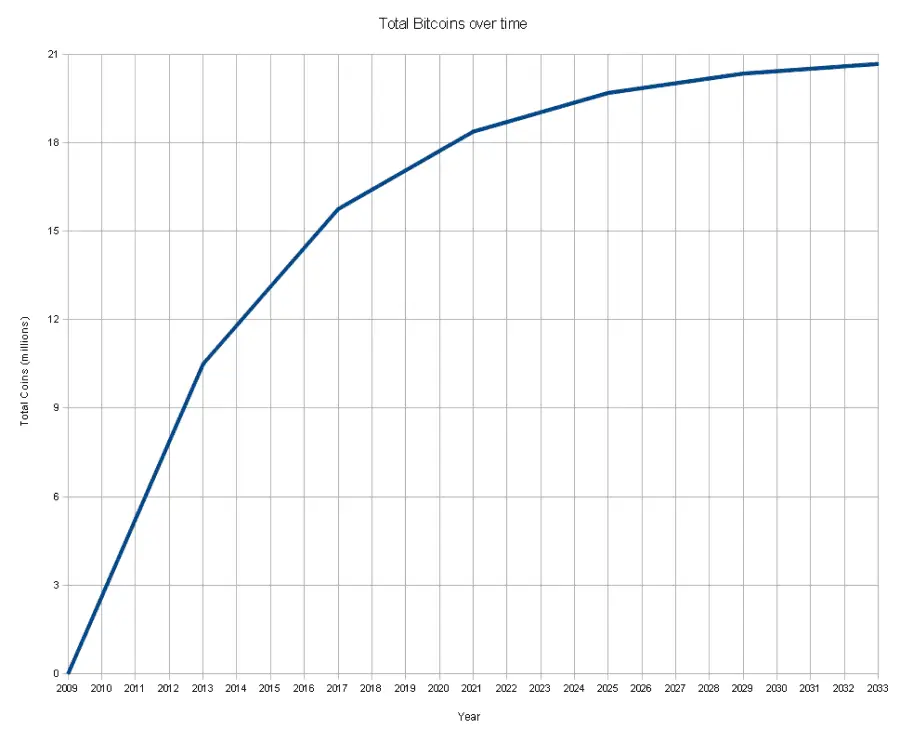
Over 95 percent of all bitcoins have been mined. This means that the new supply is now only a marginal part of the bitcoins already on the market. This has significantly reduced the impact of the halving on the market. The graph below shows the development of the Bitcoin supply until 2033.
Bitcoin trading volume currently ranges from tens of billions to hundreds of billions of dollars per day. In other words, over a million bitcoins can change hands every day.
New bitcoins are created through mining at a rate of 450 per day. Their relative impact on the daily supply is extremely small. In addition, it should be noted that new bitcoins do not immediately enter the market, thereby increasing supply.
The transition of mining to a professional business has brought a significant change. Many mining companies do not sell their mined bitcoins immediately on the market; they also hold the coins for strategic purposes.
Bitcoin bull markets have historically followed four-year cycles – just like halvings. This has led to the conclusion that halvings have caused Bitcoin’s price to fluctuate in lockstep with them. However, the market is better understood today.
For example, the COVID crash of 2020, the 2022 bear market, and the 2025 tariff crisis have shown that Bitcoin’s macro trends are closely correlated with those of other asset classes.
Few analysts consider halvings to be a significant driver of Bitcoin’s price. They likely had a significant impact during the first two halvings, but Bitcoin’s price now has more important drivers.
Bitcoin’s price can still move in four-year cycles, even if the halving is not the main driver of the cycle.
Read more about this topic in this article: Bitcoin Investing – A Beginner’s Guide.
Bitcoin halving – summary
Bitcoin halving is one of the most important mechanisms in Bitcoin. Each halving event halves the block reward, reducing the number of new bitcoins issued over time. It is the halving mechanism that governs Bitcoin’s scarcity and distinguishes it from fiat currencies.
Bitcoin is often described as a deflationary currency because of halvings. This is not true; its supply never decreases and continues to grow until it reaches 21 million. Bitcoin is actually a disinflationary currency. It means that inflation, or the growth rate of the Bitcoin supply, decreases over time.
Bitcoin is not the only cryptocurrency that uses a halving mechanism. Block reward halving is also used in a few other cryptocurrencies, but such implementations are rare in the crypto market.
The direct effects of the halving primarily affect miners, whose income decreases significantly after each halving. Historically, the rise in Bitcoin’s price has often offset the effect of the halving.
In the coming years, the discussion around halvings will likely shift toward transaction fees. Their importance will grow, but at the same time, a practical challenge will arise: if transaction fees increase too much, more people will avoid using the Bitcoin blockchain. A solution may also be found in new use cases, such as NFT transactions and DeFi applications.
The next Bitcoin halving is estimated to occur in March–April 2028. Halvings will continue for over a hundred years after this.